Tuesday, 27 June 2023

UNVEILING UGANDA'S ENVIRONMENTAL BATTLE: A CLOSER LOOK AT THE RAVAGES OF CLIMATE CHANGE

By Cassious David Kisakye

Climate change has become an undeniable reality, and its impact is felt worldwide. Uganda, known for its stunning natural beauty, rich biodiversity, and vibrant culture, is not immune to the devastating effects of this global crisis. In this article, we will explore the extensive and unique challenges that Uganda faces due to climate change. By examining alarming studies, harrowing statistics, and firsthand accounts, we will shed light on the urgent need for action. Through this exploration, we hope to garner support and win grants to combat climate change in Uganda.

Rampant Landslides: A Dire Consequence of Climate Change

In recent years, Uganda has experienced a significant increase in landslides, primarily attributed to climate change-induced factors such as intense rainfall and deforestation. According to a study conducted by the Makerere University, landslides in Uganda have doubled in the past decade. The data reveals that over 250,000 Ugandans have been displaced, with countless lives lost due to this calamity. Such devastating landslides not only result in immediate casualties but also exacerbate poverty, as communities struggle to recover from the destruction of homes, infrastructure, and farmlands.

Landslides like these in Eastern Uganda have become a common site in this region. (Courtesy Photo)

Air Quality Crisis: Choking in Uganda's Cities

Urban centers in Uganda, including the capital Kampala, are grappling with deteriorating air quality, presenting grave health risks to their residents. Rapid urbanization, vehicular emissions, and industrial activities contribute to the rising levels of air pollution. According to the World Health Organization (WHO), Kampala's air quality index consistently exceeds the safe limits, with high concentrations of particulate matter. This alarming situation has led to an increase in respiratory illnesses, such as asthma and bronchitis, and poses severe long-term health consequences for the population.

Kampala air quality has steadily become worse as the years have passed by (Courtesy Photo)

The Unseen Danger: Climate Change and the Rise of Diseases

Climate change has also triggered a worrying surge in diseases in Uganda, including cancer. Prolonged exposure to environmental toxins, contaminated water sources, and altered disease vectors has contributed to the prevalence of various cancers. A study by the Uganda Cancer Institute reveals that the incidence of cancer has doubled in the last decade, with environmental factors playing a significant role. The rising temperatures and changing rainfall patterns have also led to the spread of vector-borne diseases like malaria and dengue fever, further burdening Uganda's healthcare system.

The rise in diseases like Cancer have risen in Uganda due to the difficulties like environmental factors. (Photo credit: New York Times)

Uganda's Call to Action: Quotes from Influential Voices

Prominent personalities, renowned for their commitment to climate change advocacy, have spoken up about Uganda's environmental challenges:

1. Wangari Maathai, Nobel laureate and environmentalist, once said, "In a few decades, we will be facing a crisis in terms of access to fresh water, clean air, and fertile land. It is essential for Uganda, like all nations, to prioritize sustainable practices to mitigate the effects of climate change."

2. Jane Goodall, world-renowned primatologist, expressed her concerns, stating, "Uganda's unique biodiversity is under threat due to climate change. We must act urgently to protect the remarkable flora and fauna that make this country so special."

Figures like Wangari Maathai have been outspoken advocates of action on Climate change.

To address the escalating climate change crisis in Uganda, a comprehensive approach is required. The government, local communities, NGOs, and international partners must join forces to implement sustainable initiatives. These include reforestation programs, investment in renewable energy, improved waste management systems, and enhanced environmental education.

Uganda's battle with climate change is extensive, with far-reaching consequences for its people and the environment. The evidence of landslides, deteriorating air quality, and the rise in diseases like cancer paints a grim picture. By highlighting these issues, incorporating influential quotes, and emphasizing the urgent need for action, we hope to rally support and secure grants to combat climate change in Uganda. Together, we can protect Uganda's natural wonders and ensure a sustainable future for generations to come.

Thursday, 17 March 2022

THE 27TH UNION: THE STORY OF THEIR IMPACT

By Kisakye Cassious David

The 27th Student’s Union is a unique regime in the aspect of how it came into office.  2021 saw the first online election held in Uganda Martyrs University which ushered in H.E Cassious David and his cabinet.

Members of the 27th Union Executive with the Vice Chancellor, Prof Patrick Kyamanywa.
Photo By Lubega Simon Peter

The Students Union is a student led body that represents the views of the students to the University management and is a key player in developing the institution. The Union body has been in existence since 1994 which Prof. Vincent Bagire as the first Union President. He also now serves as the vice-chairperson of the University Governing council.

We look back at the role of the 27th Union in shaping the progress of the students and the University as a whole through the various sectors of academics, social life, health, administrative and more. This regime came into a time when the University was battling with some in-house struggles as well as the global pandemic. 

Their first two months in office were shadowed by the national lockdown that was announced by President Yoweri Kaguta Museveni. This lockdown halted all the works of the Union since there was little or no on campus business.

President Museveni directed that all schools should close in July 2021 to curb the spread of the virus.
(Courtesy photo)
Nevertheless, the student leadership still had to deliver in spite of all that was going on and this kick started in the month of August where preparations were being made to fully re-open schools. The Union was tasked with working within the limited time to attain their manifesto objectives.

We did reach out to one of the student leaders of the 27th Union Executive, Hon Akampa Fortunate who is the Health secretary. The honorable did accept to give an interview to our reporter on the progress they have made in their term of office. He spoke widely about the targets of ensuring result release delays were sorted and pushing for the creation of a new organ of government, the Union Senate to bring all campuses closer.

Listen to AKAMPA FORTUNATE PIECE.aac by CASSIOUS DAVID on #SoundCloud

https://soundcloud.app.goo.gl/b2Y86 

The 27th Union Body donates mosquito nets to the maternity ward of the Nkozi Hospital
Photo by Simon Peter

We were also informed that the 27th Union played a starring role in getting thousands of vaccines for its students to be vaccinated with over 200 students benefitting from this initiative. On the side of community service, the Union also fundraised and donated a few mosquito nets to the maternity ward of the Nkozi Hospital.

The vaccination drive organized by the 27th Union at the Nkozi Hospital
Photo By Cassious David

From the side of the University management there seemed to be some initial reservations towards this year’s cabinet performance because of the times that existed. The team came into office in a time with a dwindled budget, a global pandemic wrecking havoc, a reduced cabinet size and more. The views of Mr Jordan Jacob on the 27th Union in our interview with him. 


These fears would seem to have affected the expectations of the University of the 27th Union but that was soon changed swiftly by their performance. When we spoke to Jordan Jacob, the administrator in the Dean’s office about their appreciation of the work done by the 27th Union amidst all the challenges. He was rather proud of the team led by Cassious David and commended them for the efforts they have put in student and community engagement and also their mature relationship with the management.

The Union President and Chairperson present the student affairs report to the Management of the University.
Photo By Lucy Ntimba

We found out that the 27th Union made it an obligation to reach out to the local government officials like the Town Mayor, Hon Zed Kasule and also the Mpigi Woman MP, Hon Teddy Namboze. These engagements were done with the aim of soliciting government support for some Union projects like the establishment of the street lights in the Nkozi Trading centre.

The Mayor(L), the Union President(centre) and the Mpigi woman MP(R) during a general cleaning of the Nkozi trading centre.
Photo By Kasana Bob Williams

The students being the key partners in the plans of the Union also had to have a say. A year one student of Education, Angel Uwase told us, “Unlike other universities where the student leadership is almost alien to the students, here you see how close they are to the students”. She added, “I have seen them introduce new sports like Teq Ball, I noticed that they have advocated for infrastructural development like the radio studio and I believe this shows their impact on the University”.

The Union President flags off the Teq Ball game in Uganda Martyrs University
Photo By Babirye Scovia

Nonetheless, there still needs to be reviews into the activities of the Union and a look into how the culture of leadership can be maintained. The activities of the UMUSU haven’t been all smooth sailing but they looked to have maneuvered.

We spoke to the Deputy Vice-Chancellor, Rev Fr Dr Christopher Mukidi about the culture of leadership in Uganda Martyrs University and their impact. He alluded to the fact that the 27th Union has been exemplary in their impact on the University by creating a student centered discussion in all engagements with them.

We can clearly see that there were a plethora of challenges thrown at the 27th Union body and it needed a strategic team to maneuver through the terrain. Whilst there was a lot that they desired to attain, the limitations existed but this didn’t hold them back.
The 27th Union and Dean of Students, Mrs Roselyn Sali receive the award from the Debate Club. 
Photo By Babirye Scovia 
 We did see the introduction of new sports, sorting out of chronic academic issues like delayed release of results, amendments that brought up the Union Senate to channel the views of all campuses, the broadening of ties on a national level through community engagements and more. Under their term, they have advocated for a University presence on social media and that was sorted. 

 The Union President played a vital role in uniting all guild presidents of other universities through the body he co-chaired, the Guild Presidents Union of Uganda.
The Union President leads a team of Guild Presidents to the office of the Minster Of Security, Maj Gen Jim Muhwezi. 
(Courtesy Photo)
Perhaps the tough times required the strongest to rise to the occasion and the impact of the 27th Union can be seen in all these various sectors. From the views of the Union President, he gave off the idea that there is still a lot to be achieved by them but now their focus is on guiding their successors. A sign that their impact will stretch even beyond their term of office.

The Union President, Cassious David Kisakye addresses the audience during the installation of the 4th Vice Chancellor on March,17th 2022.
Photo By Wasswa Peter


Monday, 31 August 2020

POST COVID-19:THE NEW NORMAL FOR SCHOOLS

By Cassious David Kisakye

According to the United Nations International Children's Emergency Fund (UNICEF) 90% of the over 1billion students in the world have suffered some form of hindrance to their education because of the pandemic. Even in this uncertainty, some countries have found a way to reopen schools. 

Hi
A boy recites words in a classroom in Northern Uganda. (UNICEF) 

By June, 2020 almost 70 countries had re-opened their schools just four months into the global pandemic. Countries like S.Korea that are known for their rigorous 12 hour school schedules, reopened their schools to mostly the younger students. Whilst Denmark, the first European country to welcome back its students, did so even earlier after just a month into the lockdown.

An example of a classroom in South Korea after the reopening of schools 
(Courtesy photo) 

While closer to home, Uganda like most African countries has decided against allowing students to return almost 7 months after they were sent home. Though in recent weeks, President Museveni has hinted at their reopening. “On Friday, His Excellency met with the National Task Force team and instructed them to review the possibility of a phased reopening of schools starting with candidate classes and clinical medical students,” According to the Minister of ICT and National Guidance, Judith Nabakooba. 

Hon. Nabakooba addressing the press on the issues discussed with President Museveni about the pandemic. 
(Courtesy photo) 

Most of the measures set up for schools that have reopened are the same upon consultation with the various stakeholders like health officials of the numerous countries that have followed this path. They’ve issued measures like:

Moving classes to temporary spaces like some schools in Denmark that had a few in a cemetery. 
Holding classes in shifts to reduce class sizes and staging meal times in separate intervals. 
Very diligent testing and tracking systems are in place. 
Ready equipment like thermometer guns. 
Enforce face coverings and gloves if necessary. 
Set up facilities to foster online learning to avoid physical contacts. 
Build emergency campus sites in case of an emergency. 
Most countries have started with the younger children in the elementary classes. 

These measures are but a few of those in practice and as countries come out of  lockdown, new innovations will be designed. Countries like Japan actually did well at first when the schools reopened because of the spaced school programmes as well as the various tests done. 

However on the flip side, these standards of operations are not flawless and some would say they were premature as they have backfired in some countries. A back to School tracker created by Randa Grob-Zakhary, C.E.O of Insights for Education analyzed the experiences from 183 countries. It discovered that most countries that reopened their schools, recorded an increase in COVID-19 cases. 

Students in Israel were ordered to return home after schools were shut due to a rise in COVID-19 cases. 
(Courtesy photo) 

In Israel, the government had too close 700 schools again because of this. In South Africa just after one month, 1260 students and over 2400 teachers contracted the virus and because of this, 968 schools were closed. In Senegal, President Sali Mackay postponed the reopening of schools after an increase in infections among the teachers. While the leaders of Bangladesh and Philippines who have completely refused to open up schools again until a COVID-19 cure is found. 

A COVID-19 testing camp is set up outside a school in South Africa after a spike in cases. 
(Courtesy photo) 

In these unprecedented times when there isn’t a full proof solution at the moment, we have to be careful at jumping onto the bandwagon of theories for example, the unconfirmed belief that children aren’t as affected by the virus compared to the elderly. Its scientifically proven that kids were very effective infectors as seen in the 2009 H1N1 influenza pandemic when the virus was spread among the population. The African countries like Uganda have had to adopt the rather costly mode of online learning which is going to be a tumbling block considering that 80% of the population on the continent don’t have access to the internet.  

Students in Kampala, Uganda returning home after schools were shut in March, 2020
(Courtesy photo) 

When or if most students return to schools, they will be met with a different and almost alien system of education. That is our new normal. 


Tuesday, 26 May 2020

THE RACE TO FIND THE COVID-19 VACCINE

By Cassious David Kisakye

On December 31st, 2019 scientists in China reported cases of an unknown disease causing severe pneumonia. This disease was traced to a food market in Wuhan, Eastern China and the World Health Organization later named it, COVID-19.
The speed of the spread of COVID-19 has increased the need for a cure.
(Courtesy photo) 
Five months on and COVID-19 has spread to every continent but Antarctica. It has infected just over 2 million people and proved fatal to over 137,000 others. In that time period even Uganda hasn’t been spared as the number of confirmed cases rose to 61 in a month. With many countries under lockdown and millions at risk of infection, one question lingers on, will a cure be found? 
President Museveni has been uncompromising in his guidelines during this pandemic.
(Courtesy photo) 
The world’s most renowned virologists are looking into developing a cure and their expertise is being tested to the limit as development of vaccines is a long and tedious process.
The World Health Organization (WHO) announced the launch of a multi-country clinical study called Solidarity. This study is to begin trials on four types of vaccines, Remdesivir, which was used in the Ebola drug and appears to be effective on other viruses.
There is also Chloroquine, the anti-malarial drug which has shown it can kill the virus but WHO says there’s no definitive evidence of its effectiveness.
The third option is Interferon-beta which has shown the ability to reduce inflammation in lungs, one of the symptoms of COVID-19.
The final one is a combination of Lopinavir and Ritonavir which is still under experimentation.
A lab in Seattle, USA has been given a go ahead in furthering tests on a possible COVID-19 cure.
(courtesy photo) 
The efforts of WHO are also being backed up by many other institutions in this race against time. The available data shows 35 companies and a host of higher learning organizations are involved and they seem to be yielding results. 
With 4 vaccines already being tested on animals and over 20 others in development. The first clinical trials of a vaccine were from the Boston-based firm, Moderna and signs show that human trials are imminent. Trials on humans on a vaccine were first done in Seattle, USA and later commenced in England and Scotland using the antiviral Remdesivir and further tests are still being carried out.
There has also been involvement from the Coalition for Epidemic Preparedness Innovations(CEPI) which has set up a plan to develop a COVID-19 vaccine and boost manufacturing of it, CEPI earlier this month called for $2bn as necessary funding for this project. Pharmaceutical firm, Sanoti is also trying to build on its already-approved flu vaccine to get a suitable one to treat COVID-19.
The University of Oxford is focusing on a treatment of external Spike proteins which has shown to develop immunity against the virus.
Billionaire philanthropist, Bill Gates said his foundation is funding the construction of factories that will manufacture seven promising coronavirus vaccines. Gates told the Daily Show host,Trevor Noah: “We’re going to fund factories for all seven just so we don’t waste time in serially saying ‘ok which vaccine works’ and then building the factory,”
Bill Gates announced during his interview with Trevor Noah that his foundation was to invest billions of dollars as funding for the COVID-19 cure.
(Photo by Daily Show
The way vaccines work is that when the body is exposed to the harmless bug, it in theory develops immunity against the infection over time. With so many people behind this search for the cure, we are left with understanding what exact timeframe the world is looking at till a vaccine is got. President Donald Trump rather prematurely claimed that a vaccine would be got in a matter of months but, Prof Annelies Wilder-Smith of the Emerging Infectious Diseases at the London School of Hygiene and Tropical Medicine said: “Like most vacciniogists, I don’t think this vaccine will be ready before 18 months”.

The search for a vaccine demands patience but there already exist treatments for COVID-19 and many hospitals have used medication for influenza and other severe respiratory illnesses like fever, cough and shortness of breath to help the infected.
In some severe cases, Ventilators are used to blow air into the lungs through a mask inserted directly into the windpipe but even these costly machines are in low supply compared to the current demand for them.

Some medical experts say that the emergence of the COVID-19 pandemic hasn’t shocked them as there were signs before of another coronavirus outbreak as there already exist four of them that circulate in human beings. They cause the common cold and we don’t have vaccines for any of them.
The past Coronavirus outbreaks like Severe Acute Respiratory Syndrome (SARS) in 2002-04 and Middle East Respiratory Syndrome (MERS) in 2012 which broke out in Saudi Arabia were all a warning sign of things to come and yet the search for those vaccines was stalled when the outbreak seized. The COVID-19 disease is caused by the virus, SARS Cov-2 which shares 80% - 90% of it’s genetic material with SARS.
COVID-19 isn't the first Coronavirus but just like others, the cure doesn't exist
(Courtesy photo) 
Maybe if we had persisted with the search for the vaccine, we might have got one for COVID-19 but that is just a theory.
Unlike past vaccines that took decades to go through clinical and human trials then medical approval, we need this one as soon as possible.

Tuesday, 24 March 2020

EARTH DOESN'T NEED US BUT WE DEFINITELY NEED HER.

With many cities under lockdown, it gives us a glimpse into what the earth would be without humanity.
Many reports coming out of China indicate a steady decline in air pollution levels with NASA showing air contamination is down by 30% and this is massive considering China is the global leader in carbon emissions. These reports seem to point to the fact of how perilous our impact as humans has been on the planet.
A man moves through the empty streets of Wuhan, China which was the epicenter of COVID-19
(Business Insider) 
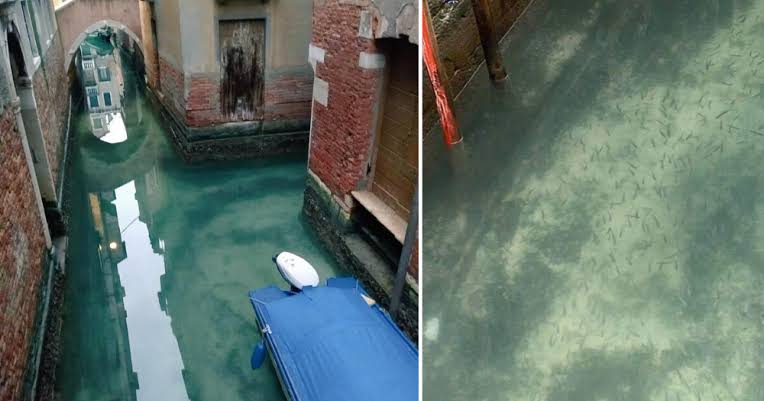
We have also seen in other countries where animals are taking advantage of the absence of us to seek comfort in our man made structures. In Venice, Italy,  the famous canals have been pictured being the cleanest they've been in decades and animals like dolphins and geese are showing  up to make themselves feel at home.
The canals of Venice look immaculate ever since humans stopped using them.
(Business Insider) 
In this vast emptiness of human presence, we see other planetary life thriving. This shows us one thing, we need to treasure mother nature more because we are just a pigment in her million years of existence. So when or if we ever get out of this pandemic we find ourselves in we need to sit back and realize that we all need Earth.

Thursday, 19 March 2020

UNCERTAIN TIMES AHEAD AS UGANDA LOCKS DOWN

On Wednesday 18th March, 2020 Uganda received the first set of guidelines of the lockdown as President Museveni looked to curb the spread of the COVID-19 pandemic.
President Museveni addresses the nation at State House on Wednesday 18th March,2020
Those revelations precceded those of Monday, 30th March as the President introduced more strict measures as the number of confirmed Corona virus cases soared to 48 within two weeks.
The Minister of Health, Ruth Acheng has had to constantly update the public on the COVID-19 situation in the country. (WHO) 
The new measures included a 14 day ban on public and private transport, all non food markets, shopping malls, bars, salons and all non-essential services. He on the other hand said that all Government offices were to be shut down except the army, police, health sector and other priority organisations like media.
Among other measures included a natiom wide curfew from 7pm to 6am which despite prior retaliation from the public was duly followed. The government hence sought the service of the Local Defence Unit along with the police to further enforce the curfew.
The streets of Kampala after the complete lockdown was announced by the President on Monday, 30th March.
(The Observer) 
The President in his address showed empathy for the estimated 1.6 million people in Kampala, he is clearly aware of the dire struggle that faces them but the virus spread must be controlled, he said, "We have  therefore decided to error on the side of caution. We must deny the virus the fuel to move."
There was however caution given to the food markets that would remain open, they were given guidelines like maintaining the 4 meter distance and all sellers should remain at the market for the 14 days.
A woman sleeps in Owino Market as they were ordered to not leave the market for 14 days on Monday.
(Courtesy photo) 
These measures attracted unrest from Ugandans as they decried the fact that they didn't have the luxury of working from home and having enough food for their households. On the back of these unrests, parliament held a session on 2nd April, 2020 to discuss the proposed shs 304 billion supplementary budget for this pandemic. Among the details debated on was the relief food aid to be delivered to the people of Kampala and Wakiso on 4th April. These food rations included 6kgs of maize flour with 3kgs of beans and salt for each person as well a 2kgs of powdered milk and 2kgs of sugar for breast feeding women and the sick.
Matia Kasaija, the Minister of Finance presents the details of the supplementary budget to parliament on Tuesday, 1st April.
(Daily Monitor) 
The current number of confirmed global cases of COVID-19 as of Friday, 3rd April, 2020 stands at 1,026,974 infected people and 53,975 deaths with countries like USA, Italy and China being the most affected. The right statistics of these cases is hard to determine because they grow each day and not all are reported.
The situation the world finds itself in is unprecdented and demands social changes to halt the spread of the virus and Uganda just like many other countries now, has decided to go the same direction of Lock down.
The Ugandan Economy will definitely feel a pinch from the Corona Virus pandemic as markets struggle.
(The East African) 
One thing is certain, there will be a lot of damage on Uganda's economy and social structures as nobody knows for how long.

Tuesday, 17 March 2020

A BILLION LIVES TURNED TO ASHES

Australia was hit with a massive heatwave from June, 2019 to January 2020 and with this, over a billion animals were lost and billions of dollars worth of human property destroyed.
A Helicopter sprays foam to help put out the fires in Canberra, Australia
(Reuters) 
2019 was a year of immense pressure on political heads to actualize plans to curb global warming efforts and sadly for the case of Australia, even the death of billions of animals and over 20 people didn't sway the government. Many climate activists had called for an end to fossil fuel mining which the state argued was bringing in lucrative deals for the country. These claims by the state simply angered the activists more with a large outcry for the Australian Prime Minister, Scot Morrison to resign.

It was because of this pressure that the Australian government issued out in excess of 10 Billion Australian pounds to help combat the fires. Though this seems like a step forward, many of the public feel more can be done or else Australia will continue to be in ash.

EUROS POSTPONED TO 2021

The corona virus pandemic has pushed the globe into a state of disorder and this is very evident in the footballing world as major tournaments and leagues have been postponed or cancelled.
UEFA President, Alexander Ceferin adressing the General Assembly on Monday morning in Monaco,France (Reuters)
The EUROS have been pushed forward by a year to June 11, 2021 as UEFA struggles to contain the spread of the virus.This comes after various consultations with health agencies on what to do at this time of unprecedented fear for life and health. The news was first brought out by the Norwegian Football Association and the European Football Governing body later confirmed the post.

The postponement  of this tournament will have a dominoes effect on other tournaments like The Nations League which was supposed to start also in June 2021 and also the 2024 FIFA World Cup qualifiers that were set to proceed in 2021.The situation the football world finds itself in mirrors that of the society, a situation never seen before and one with no immediate solution in sight. 

Wednesday, 11 March 2020

A SHOCK IN THE ROYAL FAMILY

In early January, 2020 the British Royal family was shaken to the core as the Duke and Duchess of Sussex, Prince Harry and Meghan Markle announced that they would step down as royals from the world's oldest monarch.
Prince Harry and Markle after meeting Queen Elizabeth in January
Photo:Gettyimages

These revelations come as a result of the a times harsh treatment Meghan has received from the British press. British tabloids like the Sun have published stories of how she us trying so hard to act like the Duchess of Cambridge and Prince Harry's wife. There have been even reports suggesting she is being targeted because she is from a biracial background with a White father and Dark mother.
Whatever the case behind their abdication, the Duke and Duchess have undoubtedly left a void in the family. They now plan to settle in Canada and work so as to be able to earn their own money without reliance on state funds.

Tuesday, 10 March 2020

THE CORONA VIRUS SCARE IN THE VATICAN

Pope Francis tested negative for the Coronavirus, this came after the Holy Father had to skip the Ash Wednesday mass because of a cold he has been battling.
Pope Francis coughed as he led mass on Sunday
(VaticanMedia)
These fears arise because Italy is the most affected country outside China with over 2000 people having been infected by the deadly virus. At the time of writing, Italy was the first country in Europe to go on lockdown with all of its occupants being told to isolate themselves for a minimum of a month. Italy has now been joined by France, Germany and U.S.A in adopting the social distancing policy.

2020 SET FOR MORE TAXES

The Ministry of Finance of Uganda released the 2020/2021 budget framework in December 2019 and it indicated that the amount of money from external donors will reduce and the general budget will be cut from shs 40.48 Trillion to shs 39.64 Trillion, upon release, the Minister of Planning, David Bahati explained that because of reduced external support, the public will have to cope with increased taxation to finance the budget.
Ugandans in urban centers may have to deal with increased commodity prices to cope with the rise in taxation intended to fund this year's national budget.

SUPPRESSION OF OPPOSITION

Ugandan opposition leaders like Kizza Besigye and Robert Kyagulanyi are being strangled out of view with charges like sedition and treason being placed on them anytime they air views that contrast those of the ruling government.
 Besigye visits Kyagulanyi in Rubaga Hospital after he was beaten up by alledged Government operatives in early 2019
Photo;ObserverUg

ETHIOPIA'S AMBITIOUS AFFORESTATION PROJECT.

Ever since Ethiopian Prime Minister, Abiy Ahmed came into office, he has spearhead great projects and in 2019, he kicked off a massive afforestation plan which brought together 23 million people in the African country as 353,633,600 trees were planted according to the Technology Minister, Gutahun Mekuria.
Ethiopians take part in the national tree planting day on 28th July, 2019 in the capital,Addis Ababa
Photograph: Micheal Tuwelde

LOCUSTS PUT MILLIONS AT RISK OF STARVATION

The UN declared the recent infestations of locusts in Africa as the "worst" in a quarter of a century and this is no hyperbole as this swarm of locusts carries the potential of destroying food that can feed 35,000 people in one day which is now putting over 25 Million people at the risk of starvation in 15 countries.
A UPDF soldier sprays a plantation infested with locusts in Moroto,Uganda

SYRIA REFUGEE CRISIS

With over half of the pre-war population either displaced or dead. An estimated 22 Million Syrians have had an awful life ever since the war begun. With now over 12 Million of them displaced, many of them have gone to neighboring Lebanon, Iran and over 3 Million have moved to Turkey where they have flooded the urban cities and created culture tensions which has led to many racist attacks on the Syrian refugees.
A group of Syrian refugees storm the beaches of Turkey as they flee tensions in Damascus,Syrian

Wednesday, 19 February 2020

UGANDA SHOWS AFRICA THE WAY


Many would say that Uganda has led the way in Africa when it comes to combating the issue of Climate Change, this point of view is further backed by the endeavors the state and many concerned climate activists have taken in this global fight. 
A Climate Change activist in one of the slums of Kampala, Uganda
Uganda was the first country in Africa to develop and endorse its Nationally Determined Contribution Partnership Plan (NDC-PP) in June 2018. It made key commitments in this regard, including, reducing national greenhouse gas emissions by 22% by 2030, reducing climate vulnerability of climate sensitive sectors since the economy is natural resource based, and building climate resilience of key sectors and managing disaster risks. 
This sounds like a step in the right direction for the East African country but like most of the developing world, Uganda is openly feeling the adverse effects of climate change. 
A young girl in Kasese fetches water from one the rivers that burst it banks recently. 

In October 2019, residents of Kasese were hit with floods that killed one person and displaced more than 7000 people, Uganda is combating one of the highest rates of annual forest cover loss (2.6%) in the world and despite various calls for state assistance that eventually arrives in moderation or not at all, Uganda and specifically, people living in and around Mbale have suffered from the landslides that is as a result of their encroaching on the mountain sides for agriculture. We have also felt the effects of prolonged drought in the country with five of the hottest years in modern human history coming in the past decade.
The streets of Kampala battle floods all the time because of the poor drainage system. 

This may taint a sad and horrific future for future generations but as said before, Uganda can hold its head high when discourse about climate change combat is put forth, Uganda has been the beneficiary of a lot of funds that the state is putting to work. In Lira, they have kicked off a tree planting project with the aim of restoring all the lost forest cover, in Kasese which also happens to be the most at the frontline of renewable energy use in Uganda has seen a increase in use of clean energy from 3% in 2012 to 28.9% in 2018. 

Uganda has also received various donations and grants to help facilitate the fight with The Lake Victoria Management Project implemented by the Ministry of Water and Environment being funded by a $90 million International Development Association credit. In 2016, the World Bank approved $2million for the Uganda Clean Cooking Supply Project which advocates for clean energy in households. 
Uganda has from 2016 been backed by over $250Million from the World Bank which has been used in many projects ranging from research into more environmentally friendly Agriculture to technological innovations.

All these efforts maybe just a drop in the ocean in this global struggle but as a country, Uganda has shown the World that we need to act now and as former US President, Barack Obama once said, “Climate Change is no longer some far away problem; it is happening here, it is happening now!”
BY CASSIOUS DAVID KISAKYE

Tuesday, 19 November 2019

WHAT IS HELL


The Christian belief in hell has developed over the centuries, influenced by both Jewish and Greek ideas of the afterlife


The recent dispute over whether Pope Francis denied the existence of helin an interview attracted wide attention. This isn’t surprising, since the belief in an afterlife, where the virtuous are rewarded with a place in heaven and the wicked are punished in hell, is a core teaching of Christianity.
So what is the Christian idea of hell?

Origins of belief in hell


Depiction of the seven deadly sins and the four last things of man (death, judgment, heaven and hell). Hieronymus Bosch or follower.
The earliest parts of the Hebrew Bible, around the eighth century B.C., described the afterlife as Sheol, a shadowy, silent pit where the souls of all the dead lingered in a minimal state of silent existence, forever outside of the presence of God. By the sixth century B.C., Sheol was increasingly viewed as a temporary place, where all the departed awaited a bodily resurrection. The righteous would then dwell in the presence of God, and the wicked would suffer in the fiery torment that came to be called “Gehenna,” described as a cursed place of fire and smoke.
Early depictions of the afterlife in ancient Greece, an underworld realm called “Hades,” are similar. There, the listless spirits of the dead lingered in an underground twilight existence, ruled by the god of the dead. Evildoers suffered gloomy imprisonment on an even deeper level called “Tartarus.”
Beginning in the fourth century B.C., after the Greek King Alexander the Great conquered Judea, elements of Greek culture began to influence Jewish religious thought. By time of the first gospels, between 65 and 85 A.D., Jesus refers to the Jewish belief in the eternal fire of Gehenna. Elsewhere, he mentions evildoers’ banishment from the kingdom of God, and the “blazing furnace” where the wicked would suffer sorrow and despair and “where there will be weeping and gnashing of teeth.” Jesus also mentions the Greek Hades when describing how the forces of evil – “the gates of Hades” – would not prevail against the church.

Medieval ideas of hell

In early Christianity, the fate of those in hell was described in different ways. Some theologians taught that eventually all evil human beings and even Satan himself would be restored to unity with God. Other teachers held that hell was an “intermediate state,” where some souls would be purified and others annihilated.
The image that dominated in antiquity eventually prevailed. Hell was where the souls of the damned suffered torturous and unending punishment. Even after the resurrection of the dead at the end of the world, the wicked would be sent back to Hell for eternity.
By the beginning of the fifth century, this doctrine was taught throughout western Christianity. It was reaffirmed officially by popes and councils throughout the Middle Ages.
Medieval theologians continued to stress that the worst of all these torments would be eternal separation from God, the “poena damni.” Medieval visions of the afterlife provided more explicit details: pits full of dark flames, terrible cries, gagging stench, and rivers of boiling water filled with serpents.


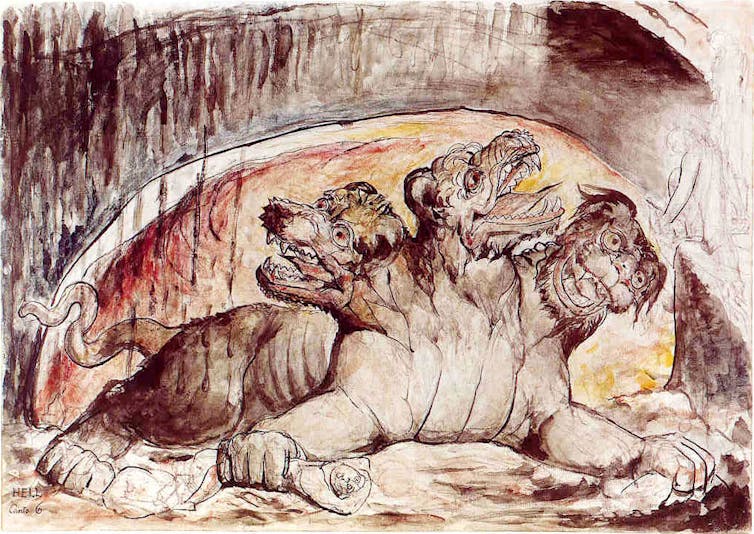
Cerberus, with the gluttons in Dante’s third circle of hell. William Blake

Perhaps the most fulsome description of hell was offered by the Italian poet Dante at the beginning of the 14th century in the first section of his “Divine Comedy.” Here the souls of the damned are punished with tortures matching their sins. Gluttons lie in freezing pools of garbage, while murderers thrash in a river of boiling blood.

Hell is God’s absence

Today, these images seem to be part of a past that the 21st century has outgrown. However, the official textbook of Catholic Christianity, the “Catechism of the Catholic Church,” reaffirms the Catholic belief in the eternal nature of hell. It omits the gory details found in earlier attempts to describe the hellish experience, but restates that the chief pain of hell is eternal separation from God.
The Vatican insisted that the pope was misquoted by the journalist. But theologians have pointed out that Pope Francis has stressed the reality of hell several times in recent years. Indeed, for today’s Catholics at least, hell still means the hopeless anguish of God’s absence.


Disclosure statement

Joanne M. Pierce is a Roman Catholic member of the Anglican-Roman Catholic Consultation in the USA, a national ecumenical dialogue group sponsored by the United States Conference of Catholic Bishops and The Episcopal Church.

Partners

College of the Holy Cross provides funding as a member of The Conversation US.
The Conversation is funded by the National Research Foundation, eight universities, including the Cape Peninsula University of Technology, Rhodes University, Stellenbosch University and the Universities of Cape Town, Johannesburg, Kwa-Zulu Natal, Pretoria, and South Africa. It is hosted by the Universities of the Witwatersrand and Western Cape, the African Population and Health Research Centre and the Nigerian Academy of Science. The Bill & Melinda Gates Foundation is a Strategic Partner. more
CC BY ND
We believe in the free flow of information
Republish our articles for free, online or in print, under Creative Commons licence.